Blog
Alice in Bookland: My First Bokmässan and the Wonderland of Forskartorget
Alice in Bookland: My First Bokmässan and the Wonderland of Forskartorget
By Dr. Zorana Kurbalija Novičić, PhD in biology, founder of Science Market Uppsala and author of Naučni kuvar (The Scientific Cookbook) · September 2026 · 6 min read
In short: In September 2026, Dr. Zorana Kurbalija Novičić, a biologist and science communicator based in Uppsala, visited the Gothenburg Book Fair (Bokmässan) for the first time. She took part in debates on fighting pseudoscience and getting children to read more, discovered Forskartorget, the fair's popular science stage, and set a goal: to present a Swedish translation of her Scientific Cookbook at Bokmässan 2027.
At our house, the most common word is WHY. The answer BECAUSE is forbidden by family rules. So when I walked into Svenska Mässan in Gothenburg this week, I did what I always tell my three little scientists to do: I stepped into the unknown and started asking questions.
This was my first time up close with the Swedish publishing world. I had books in my bag, a lot of courage in my pocket, and no idea how deep the rabbit hole would go.
Falling into Bookland
It felt like falling into Wonderland, only made of books. Everywhere I turned there was another door to open: publishers, librarians, teachers, researchers, authors, and children carrying bags full of new books. Curiouser and curiouser.
What is Forskartorget at Bokmässan?
Forskartorget is the book fair's biggest arena for popular science, where a curious audience gathers to hear the latest research. It covers history, literature, language, medicine, economics, technology, and social and educational science.
For me it was the tea party I didn't want to leave. Every talk opened a new door, and I sat there like a child at her first science show, thinking: these are my people.
How do we fight pseudoscience? Teach children how to check
You don't beat myths by shouting facts louder. You beat them by teaching people how to check:
- What did we expect?
- What did we see?
- Can we try again and get the same result?
A child who has tested whether yeast needs sugar has already learned the method that protects against misinformation. Pseudoscience asks you to believe. Science asks you to look.
How do we get kids to read more and stay curious?
Getting children to read needs structure, not only good intentions. Schools, libraries, publishers and families each hold one piece, and the family is the most important one, because curiosity grows at the kitchen table long before it grows in the classroom.
The timing was perfect. One of this year's themes was folkbildning (popular education): the 2026 themes were Québec, Folkbildning and Games, with Folkbildning organised together with Folkbildningsrådet, the Swedish Academy, the University of Gothenburg with Folkuniversitetet, and the Swedish Bible Society.
Fact: the Gothenburg Book Fair in numbers
- Founded: The book fair has been held every year since 1985.
- First fair: It was called Bibliotek 85, opened on 23 August 1985, and had about 5,000 visitors.
- Size today: It began mainly as a trade fair for librarians and teachers, and it has grown into the largest literary festival in Scandinavia and the second largest book fair in Europe after Frankfurt.
- 2026 dates: The fair ran from 24 to 27 September 2026 at Svenska Mässan in Gothenburg.
Key players in Swedish science communication and popular science
Organisation | What they do |
Forskartorget (Bokmässan) | Popular science stage at the Gothenburg Book Fair |
Vetenskap & Allmänhet (VA) | Researches public trust in science and runs ForskarFredag (Researchers' Night) |
Vetenskap och Folkbildning (VoF) | Fights pseudoscience and names the "Förvillare" and "Folkbildare" of the year |
Folkbildningsrådet & Folkuniversitetet | Popular education and study associations across Sweden |
University of Gothenburg, Lund University | Bring researchers to the public, including at Bokmässan |
Vetenskapsfestivalen Göteborg | One of Sweden's largest science festivals |
Universeum | Science centre in Gothenburg for hands-on learning |
Nobelprismuseet & KVA | School programmes and science outreach |
Forskning.se, Forskning & Framsteg, Vetenskapsradion | Research news in Swedish |
Fri Tanke, Natur & Kultur, Volante, Bonnier Fakta | Popular science publishers |
Kulturrådet & Läsrörelsen | National work to get children reading |
What is the Scientific Cookbook (Naučni kuvar)?
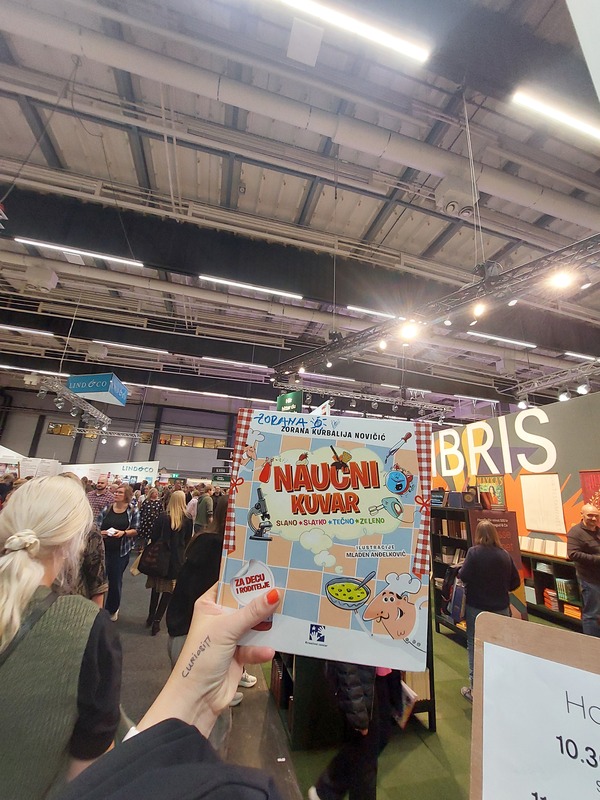
Naučni kuvar (The Scientific Cookbook) is a book for children and parents that turns the kitchen into a science lab. It has four chapters, Salty, Sweet, Liquid and Green, with 50 activities where recipes and experiments take turns, illustrated by Mladen Anđelković. It is published in Serbian by Kreativni centar (2024) and grew out of experiments I showed at science festivals and Researchers' Nights across Europe.
Examples of kitchen science experiments for kids:
- Salty: Why does salt melt ice? Why does bread rise?
- Sweet: What happens to sugar when it becomes caramel?
- Liquid: Why don't oil and water mix, and how does mayonnaise make them friends?
- Green: Why does red cabbage change color? It's a natural pH indicator.
Every recipe is an experiment, and every experiment ends with something to taste. Just like Alice's "Eat me" cake, except here you find out why things change.
The active listening routine: 5 steps to raise a curious child
- Ask before you explain. "What do you think will happen?" That's a hypothesis.
- Wait five seconds. The best answers come after the silence.
- Repeat back what you heard. Children feel taken seriously and often correct themselves.
- Observe together. Look, smell, measure, taste. Everyone is a researcher.
- End with a new WHY. A good experiment ends with the next question.
Building a new network in Sweden
It takes courage to walk into a new country's cultural world with a book in another language and a Swedish that is still learning to walk. But I came home with new contacts: teachers who want visits, librarians who want workshops, and parents asking, "When can we get this in Swedish?"
Now I want to bring Science Market into more Swedish schools, libraries and family homes, because every home can be a research lab and every parent can be a role model.
Goal: the Scientific Cookbook in Swedish at Bokmässan 2027
My goal, written down so you can hold me to it: present Den vetenskapliga kokboken, the Swedish edition of the Scientific Cookbook, at Bokmässan in Gothenburg in 2027.
Are you a publisher, translator, teacher, librarian or parent who believes in this? Contact Science Market Uppsala.
Spark curiosity, and kids will do the rest! 🧪🍳
Frequently asked questions
When is Bokmässan in Gothenburg?
Every year in late September at Svenska Mässan. In 2026 it ran from 24 to 27 September.
What is Forskartorget?
It is the popular science stage at Bokmässan, where researchers present new findings to the public.
What is Science Market Uppsala?
Science Market Uppsala, founded by Dr. Zorana Kurbalija Novičić, offers science birthday parties, experiment kits and workshops that turn family homes into research labs.
Is the Scientific Cookbook available in Swedish?
Not yet. It is published in Serbian as Naučni kuvar, and the goal is a Swedish edition by Bokmässan 2027.
How can parents help children fight misinformation?
By doing simple experiments at home: guess, test, observe and repeat. Children who learn how to check facts are harder to fool.
About the author: Dr. Zorana Kurbalija Novičić holds a PhD in biology from Belgrade and works in proteomics in Uppsala. She is a science communicator, the founder of Science Market Uppsala, the author of Naučni kuvar, and a mother of three curious kids.