Blog

Curious by Nature: The Story Behind Science Market Uppsala
Science Market Uppsala AB brings hands-on science for kids to families across Uppsala and beyond, through a mobile science lab built on one simple idea: curiosity, given the right space to grow, changes everything. Here’s the story of how a kitchen in Belgrade turned into a company dedicated to family science activities in Sweden.
Where It All Started: A Kitchen Full of Questions
I still remember the kitchen in Belgrade where it all started- not a lab, just our family kitchen, where I was the kid who wouldn’t stop experimenting with edible ingredients and asking why. Why does bread rise? Why do seasons change? Why do some of us look like our grandmothers and some don’t?
My parents didn’t always have the answers, and looking back, that was the best gift they could have given me. A question nobody can answer yet isn’t a dead end-it’s an invitation. They gave me space to experiment, to ask, and to be heard when I did. That combination-curiosity met with real listening-shaped who I am today, and I’ve built my entire career, and now my company, around saying yes to it.
From Population Genetics to Science Communication
That “yes” took me through the Sixth Belgrade Gymnasium and into the Faculty of Biology at the University of Belgrade, where I found a name for what I’d been chasing all along: the beauty of variability hidden in population genetics. I fell in love with the quiet mathematics inside living things-how a single gene drifts through generations, how climate leaves fingerprints in DNA, how the story of a species is written in a code too small to see and too vast to ignore. I became fascinated by adaptation to new environments as a concept long before I understood how much I’d need it myself.
I earned my PhD in 2009 and stayed on as a researcher and lecturer, at a time when Serbian science was still rebuilding after a decade that had scattered so many of our best researchers abroad. I could have seen that as a wall. Instead, I treated it like a hypothesis-something to test, not accept. My motto became Nulla dies sine linea: let no day pass without adding one new line to what you know.
It took five tries and a discouraging round of reviews before I won a prestigious Marie Curie fellowship, but I didn’t give up-I studied the feedback, understood what was missing, and tried again. Curiosity and courage: that is the formula.
Moving to Uppsala, Sweden: A New Chapter in Research and Personal Development
In 2015, that fellowship carried me, my husband, and our two children from Belgrade to Uppsala University in Sweden-my next experiment, testing curiosity and courage against a new culture, a new system, a new language. Nothing about it was easy, but it gets easier when you keep an open mind and stay curious enough to explore and adapt, while still holding on to your authentic self and finding your own place to grow. Finally, I had the chance to pursue high-quality research on my own terms, properly funded, in a place where cake days replaced war anniversaries on the calendar.
Why I Turned Our Kitchen Into a Science Lab for Kids
Curiosity doesn’t stay politely inside a laboratory. By the time I had three children, “why” had become the most-used word in our house, and “because I say so” was banned by family decree. Remembering my own childhood, I turned our kitchen into a laboratory for hands-on science experiments for kids.
Almost sixteen years of fielding my children’s impossibly big questions taught me something no scientific journal ever could: if you can’t explain it simply, you don’t understand it well enough yet-and if you don’t stop to really listen to the question behind the question, you’ll never get there at all.
Those kitchen experiments eventually became a published book, Naučni kuvar (The Science Cookbook)-a scientific cookbook where every recipe is also an experiment, and every experiment is edible. It’s currently published in Serbian, and I’m hopeful that families will soon be able to read it in English, Swedish, and many more languages.
Almost Twenty Years in Front of Half a Million Curious Faces
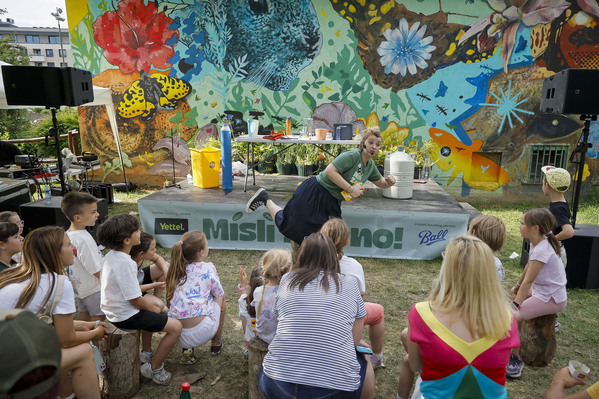
By the time I founded Science Market Uppsala, science communication wasn’t a new chapter for me-it was already the better part of two decades of my life. I’ve stood in front of well over half a million children in almost every setting imaginable: on stage at science festivals, in EU-funded public engagement projects like European Researchers’ Night, inside national STEM education programs, in school classrooms running hands-on workshops, and yes, at kitchen tables during birthday parties, turning a room full of six-year-olds into a room full of scientists for an afternoon.
Every one of those settings taught me the same thing: kids don’t need a lecture, they need an experience-something to touch, mix, question, and get a little bit wrong before they get it right. My job isn’t to hand them answers. It’s to open a space where their own questions feel worth asking out loud, and where someone is genuinely listening when they do. That’s how you raise a generation of innovators-not by filling them with facts, but by protecting their instinct to wonder and giving it somewhere safe to go.
Why I Founded Science Market Uppsala AB
That same instinct-that science belongs on the kitchen table, not just the lab bench-is exactly why I founded Science Market Uppsala AB. But curiosity is only half the equation. Along the way, I realized that the families I worked with needed more than science activities; they needed a way to actually hear each other-different perspectives, different worries, different ideas, all colliding around the same dinner table.
So I developed and published the I Hear You game, an active listening game for families that opens the floor for healthy communication. Curiosity paired with real listening is, in my view, the best foundation a family can build on-it’s how households learn to solve problems together and feel good doing it, and it’s how kids absorb values like empathy, emotional intelligence, and collaboration almost without noticing they’re being taught at all.
I’ve worn many hats: researcher, university lecturer, director of Serbia’s national Center for the Promotion of Science, and now a hybrid of scientist and business leader in the biotech industry, mom. Every one of those roles taught me the same lesson-innovation happens when curiosity meets collaboration, when complex science is translated into wonder that anyone, at any age, can grab hold of, and when people take the time to actually listen to one another while they do it.
Science Market Uppsala is my answer to that lesson: a place built for kids who ask too many questions-which is exactly the right number. We bring hands-on, playful, real science activities straight to your home with our mobile lab, designed the way I’ve always believed science education should be: approachable, joyful, and relevant to everyday life. You don’t need a lab coat to think like a scientist. You just need to notice something, wonder about it, say it out loud to someone who’s listening, and refuse to accept “because I say so” as an answer.
My Mission: Making Science Approachable for Every Curious Mind
I’m a mother of three curious minds who still run experiments with me in our kitchen lab. I’m a scientist who believes evidence-based thinking and active listening matter as much in leadership as they do in research. And I’m the founder of a company built entirely around one conviction: curiosity, given the right space to grow- and the right ears to be heard by-changes everything.
Welcome to Science Market Uppsala. Let’s ask why, together.
Frequently Asked Questions
What does Science Market Uppsala do?
Science Market Uppsala AB brings playful, hands-on science activities to homes, schools, and events across Sweden through a mobile science lab, designed for children and families to explore real science together.
Who founded Science Market Uppsala?
Science Market Uppsala was founded by Dr. Zorana Kurbalija Novičić, a population geneticist and science communicator with nearly twenty years of experience engaging children in science across Europe.
What age group are the activities designed for?
The activities are designed to be approachable for children of all ages but with best effect between 5-12 years old, with formats adapted for school workshops, birthday parties, festivals, and family events.
Is prior science knowledge required to enjoy the activities?
No. The experiments are built to be hands-on and easy to follow-you don’t need a lab coat or a science background to think like a scientist.
About the Author: Dr. Zorana Kurbalija Novičić holds a PhD in population genetics and is the founder of Science Market Uppsala AB. For almost twenty years, she has brought hands-on science to more than half a million children through science festivals, EU-funded projects such as European Researchers’ Night, national STEM education programs, school workshops, and family events. Her background spans academic research, scientific communication, and the biotech industry operating globally but based in Sweden. Curious by nature, scientist by training, optimist by decision.