
Blog
How to Spend Quality Time With Your Kids: Learn Together Through Baking and Science
Why quality time matters more than ever
Our children grow up surrounded by popular culture, reality-TV celebrities and social media, which has become one of their main ways of communicating. Professional sport, which could teach effort and fair play, too often sends the opposite message.
The internet puts endless information one click away. But is it accurate, and do children know how to judge it? Many come to believe that anything they find online counts as knowledge.
As a scientist and a parent, I see the effects every day:
• Instant answers are expected. Children want the solution now, without the search.
• Wealth is admired for its own sake, regardless of how it was earned.
• Communication moves online. A growing share of children's social life happens through a screen.
• Everyday courtesy fades. Some children no longer greet people they know.
None of this is the children's fault. It reflects the environment we, the adults, have built around them.
Why busy parents reach for screens
Modern parents are stretched thin. We juggle demanding jobs with school runs, activities, meals and household logistics. When energy runs out, a tablet or phone is the quickest way to keep a child occupied — and every parent, me included, has done it.
The problem isn't any single moment of screen time. It's when screens quietly replace the conversations, questions and shared experiences children need to grow.
What “high-quality time” with children actually means
High-quality time is not about hours or expensive outings. It has three ingredients:
1. Full attention. Phones away — for parents too.
2. Doing something together, not just being in the same room.
3. Room for the child's questions. You don't need all the answers; finding them together is the point.
Time is a parent's most valuable resource, and we decide how to spend it. Routines can change. Being a parent means more than providing for the family: we are raising the people who will shape the future.
Turn everyday activities into science for kids
You don't need a lab. Your kitchen is already full of chemistry, biology and physics. Some easy starting points:
• Baking bread or buns — yeast, fermentation and why dough rises.
• Making pancakes or meringues — how heat and whisking change proteins.
• Red-cabbage juice — a natural pH indicator that changes colour with lemon juice or baking soda.
• Freezing and melting — why salt melts ice on winter pavements.
• Growing cress on cotton wool — what seeds need to germinate.
Ask open questions as you go: What do you think will happen? Why? How could we check? That simple loop — guess, test, look again — is the scientific method, and it is exactly the habit children need to judge what they read online.
Example: baking Swedish lussekatter (saffron buns) as a family science lesson
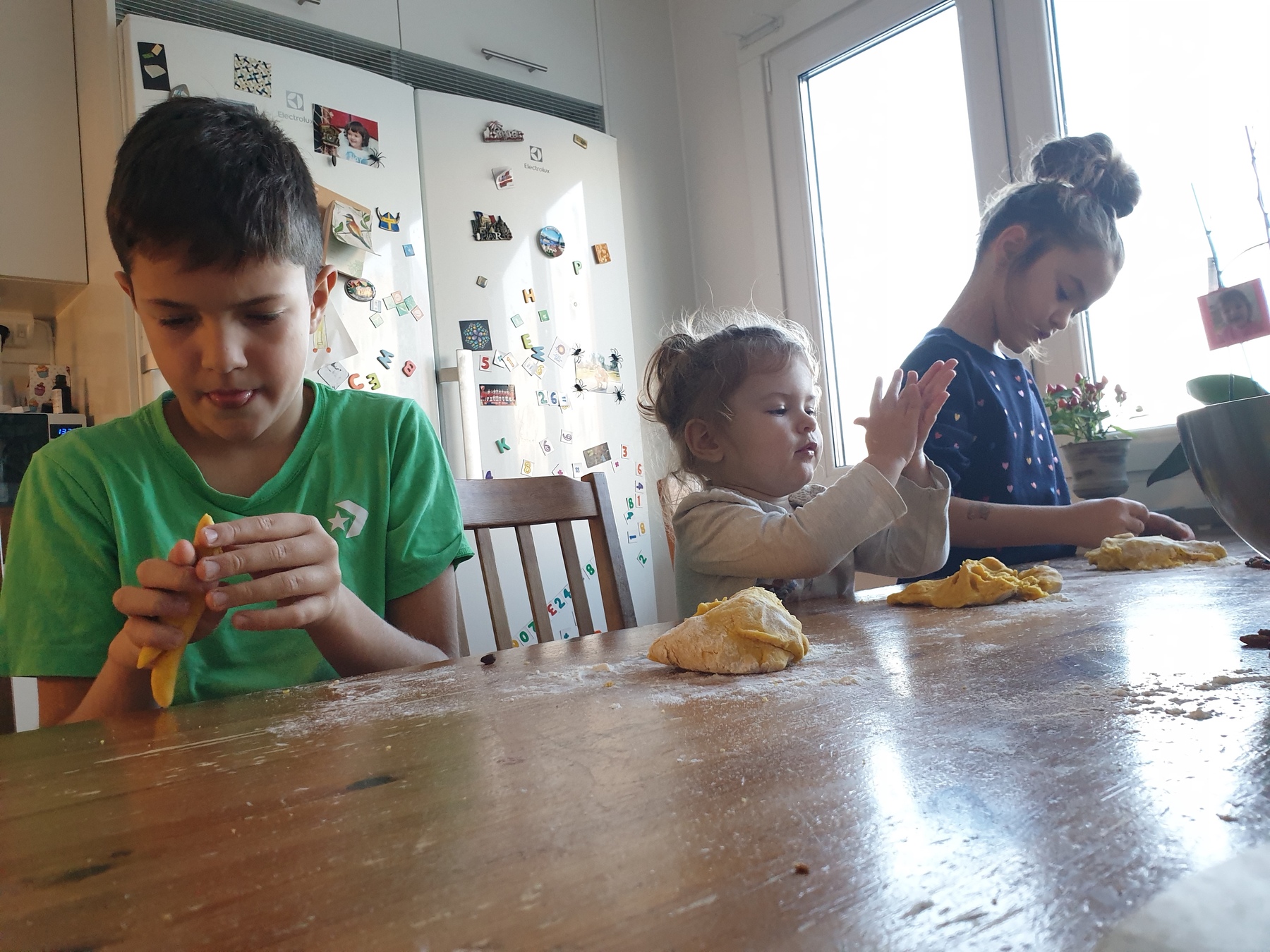
In December, my three children (then aged 9, 6 and 2) and I baked lussekatter, the S-shaped saffron buns traditionally eaten in Sweden around St Lucia Day on 13 December. One afternoon in the kitchen became four lessons at once:
• Culture and tradition: why Swedes bake saffron buns for Lucia, and how holiday traditions travel and change.
• Botany and geography: saffron is the dried red stigma of the saffron crocus (Crocus sativus). Each flower has only three stigmas, picked by hand — which is why saffron is one of the world's most expensive spices. We looked at where the plant is grown today and how the spice spread along ancient trade routes.
• Biology — yeast: baker's yeast (Saccharomyces cerevisiae) is a living, single-celled fungus. When it feeds on sugar it releases carbon dioxide gas, and those tiny bubbles make the dough rise.
• A reward: warm, golden buns we could eat together.
Try it: the yeast balloon experiment
While your dough rises, show children what the yeast is doing:
1. Pour warm (not hot) water into a small plastic bottle, about a third full.
2. Add one packet of dry yeast and a tablespoon of sugar. Swirl gently.
3. Stretch a balloon over the bottle's neck.
4. Wait 20–30 minutes and watch the balloon inflate with carbon dioxide.
Questions to ask: What happens without sugar? With cold water? With very hot water? Set up three bottles and compare — your child has just designed a controlled experiment.
More ideas coming to this blog
On this blog I'll share practical recipes and simple experiments that combine family time with learning — with clear, step-by-step instructions you can follow at home. If you'd like a hands-on science experience for a birthday or group, see Party with a science and The Listening game.
Let's spend high-quality time with our kids — and encourage them to keep asking questions, searching for answers and learning for life. Stay tuned!
Frequently asked questions
How much quality time do children need each day? There is no fixed number. Short, regular moments of full attention — even 15–20 minutes a day — matter more than occasional long outings.
What are good screen-free activities for kids at home? Cooking and baking, simple kitchen experiments, board games, reading aloud, building, gardening and nature walks all work well because they involve hands, conversation and questions.
How can I teach my child science without being a scientist? You don't need the answers. Ask “what do you think will happen?”, test it together and talk about the result. Curiosity is more important than expertise.
What age can children start baking and doing experiments? Toddlers can pour, stir and watch from around age two with close supervision; older children can measure, time and record results themselves.
Why does yeast make dough rise? Yeast is a living fungus that eats sugar and releases carbon dioxide gas. The gas gets trapped in the dough as bubbles, making it rise and become light.
Photos: Me and my 3 kids (9, 6 and 2-years old) are baking saffron bread (Lussekatter in Sweden). Spending high quality time together, talking about baking traditions, saffron plant origin (Saffron crocus) and distribution; learning by experiment about yeast biology and - at the end we have our own tasty product.


Here you can read how Universitetsläraren shared what we do:
https://universitetslararen.se/2019/05/28/hon-vill-na-ut-med-vetenskap-till-barn/