Blog

Lemon Lab at SciFest Uppsala 2026: Hands-On Kitchen Science for Kids and Families
Lemon Lab at SciFest Uppsala 2026: Hands-On Kitchen Science for Kids and Families
In short: At SciFest Uppsala 2026 (8–10 October, Fyrishov), Science Market Uppsala ran Lemon Lab, a free hands-on science workshop where children squeezed lemons, made their own lemonade, measured acidity with red cabbage and took home a lemon seed to grow. School classes came on Thursday and Friday, and Uppsala families came on Saturday. About 85% of the children had never made lemonade or squeezed a lemon before. For more kitchen science, family workshops and science birthday parties in Uppsala, visit www.sciencemarket.se.
På svenska: Science Market Uppsala var med på SciFest Uppsala 2026 med Lemon Lab, där barn och familjer pressade citroner, gjorde egen lemonad och testade pH med rödkål. Vill du göra vetenskap med barnen hemma eller boka ett vetenskapskalas i Uppsala? Besök sciencemarket.se.
One lemon, two hands, three days at Fyrishov
What happens when you hand a child half a lemon and say, "It's all yours. Get every drop out"? From 8 to 10 October 2026, we asked that question again and again at SciFest Uppsala, and the answers surprised us.
This was my third time at SciFest in Uppsala with Science Market Uppsala. This year we came with Lemon Lab: science you can taste, see and feel. One ordinary lemon became our door into chemistry, biology and a little bit of history. Thursday and Friday belonged to school classes. Saturday belonged to families.
One number has stayed with me ever since: 85% of the children at our table had never made lemonade, and did not know how to squeeze a lemon.
SciFest: Uppsala's festival of curiosity
SciFest is Uppsala's science festival, and it is free and open to everyone. Uppsala University started it in 2012, and since 2020 it has been run together with SLU, the Swedish University of Agricultural Sciences. The name comes from Finland: the SciFest trademark belongs to the University of Eastern Finland, and Uppsala University holds a licence.
The recipe stays the same every year. There are three days at Fyrishov. The first two are for school classes from middle school to upper secondary, and on Saturday anyone can come. Visitors don't just look at science. They build, test, smell, taste and talk with real researchers.
The Lemon Lab: real-life skills, one lemon at a time
Lemon Lab ran as six drop-in sessions a day, each 45 minutes long and each built around one experiment. Our motto was printed on every handout: No rush. That's how research works. Nobody had to race to finish first. Every child got the time to do the whole experiment, from start to finish, with their own hands.
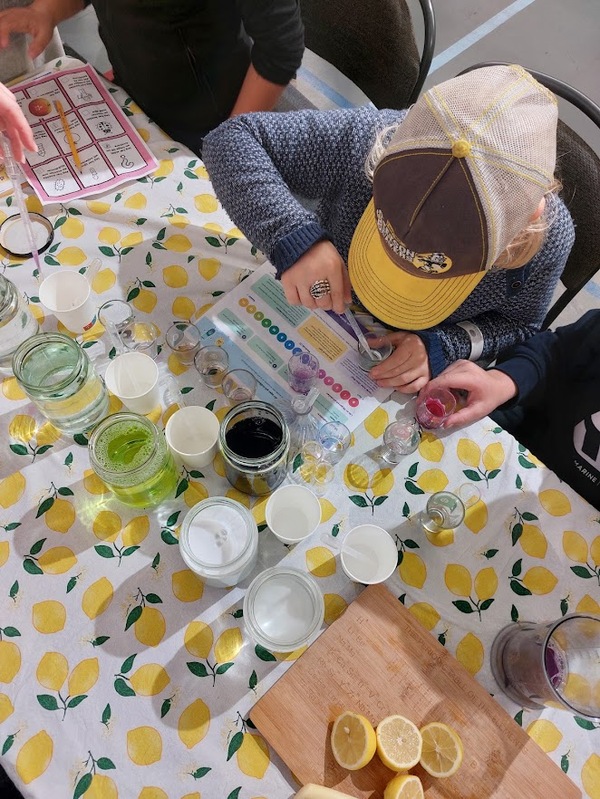
Lemonadstationen (the Lemonade Station). This is where real-life skills begin. You roll the lemon half against the table until it goes soft, then press and squeeze until every drop is out. There's no machine, just you and the lemon. It's a game of focus and fine motor skills, and it ends with a proud "I did it myself!" Then you mix the juice with water and sugar and taste your way to the perfect lemonade. More sugar? More lemon? You decide. While the children stirred, we talked about the lemon's long journey from Asia and about the sailors who ate citrus to stay healthy at sea.
The last step turns the drink into an experiment. A few drops of red cabbage water go into a spoonful of lemonade, and the colour turns pink. Here is the science surprise: sugar changes how sour lemonade tastes, but not how acidic it actually is. The red cabbage tells the truth.
Fröstationen (the Seed Station). Children rinsed lemon seeds and laid them on damp paper in a small tray. Then they covered the tray with plastic film to make a tiny greenhouse and took it home. Each child also got a lab sheet, My Lemon Tree, with space for a hypothesis ("My seed will sprout after ___ days") and a weekly log: does the seed swell, does the shell crack, can you see a white root tip?
Köksdetektiverna (the Kitchen Detectives). Is lemonade sour? What about washing-up liquid? With a pipette and red cabbage indicator, young detectives tested everyday liquids: lemon juice, vinegar, milk, water, sugar water, salt water, baking soda and washing-up liquid. They guessed first, then placed each one on the pH scale from 1 to 14.
Cooking is science, and the kitchen is the first lab every child has.
Thursday and Friday: whole classes in the lab
On the school days, classes came to us in waves from 9:00 to 15:40. Two sessions of each experiment ran every day, so a class could join at any point. Before the festival, we asked teachers to start the conversation in class with one question: What is the sourest thing in your kitchen?
Our demonstrators had three ways to explain pH, for grade 3, grade 5 and grade 8. They asked each child which grade they were in and picked the explanation to match. For the youngest, the red cabbage is simply a colour detective. For the oldest, it's a molecule called anthocyanin that changes shape when acidity changes.
The golden rule at every station was the same: ask before you tell. "What do you think will happen?" comes first. A wrong guess is also a result. And the hands always belong to the child. We show and help, but the child does the work.
Saturday: a family science day in Uppsala
On Saturday, Lemon Lab opened to everyone, and the roles changed. The child led, and the adult was the lab partner. At the lemonade station, the child rolled and squeezed while the parent tasted and gave feedback. At the Kitchen Detectives, the whole family guessed first and then let the red cabbage decide who was right.
We kept the doors open all day, lunch included. Behind every experiment we practised one small conversation routine, Listen like a scientist:
- Ask. Let the child ask their own why. No question is too small.
- Explore together. Test with what's in front of you. The adult is a partner, not the expert.
- Listen and share. Mirror what the child says, "I hear that you think…", and the next question appears on its own.
The seed boxes went home with the families, so the experiment continues at the kitchen table. Our suggestion is a five-minute lab meeting once a week: look at the seed, measure the root, and write one line in the lab sheet. The step-by-step guide is on our blog: Grow a Lemon Tree from Seed with Kids. For more listening games for the whole family, see The Listening Game.
85%: the number that surprised us
Here is what struck me most this year. About 85% of the children at our lemonade station had never made lemonade. Most of them did not know how to squeeze a lemon. Some held the half the wrong way. Some pressed once and gave up. Many looked up at us, surprised, when we said, "Now it's your turn."
This isn't about lemons. It's about real-life skills: using your hands, reading a recipe, tasting and adjusting, and finishing what you started. Today's children are surrounded by ready-made juice in cartons and bottles. They don't often get to see where the drink actually comes from.
What moved me was how fast it changed. After a minute of rolling and squeezing, the same children were concentrating hard, juice running down their wrists, chasing the very last drop. Then came the smile. "I can do it myself!" is a powerful feeling, and it is where scientific thinking starts: I can try. I can test. I can find out.
So here's my small ask to every parent and teacher who reads this: give the lemon to the child. It takes five minutes and costs a few kronor, and it builds confidence that lasts much longer.
Thank you, Uppsala
A big thank you to the SciFest team at Uppsala University and SLU for having us back for the third time. Thank you to our demonstrators, who cut lemons and wiped tables all day and kept the queue calm. And thank you to every teacher, parent and young scientist who came to our table.
Frequently asked questions
What is SciFest Uppsala? SciFest is Uppsala's free science festival, run by Uppsala University and SLU at Fyrishov. It started in 2012. It now takes place every October over three days: two for school classes and one Saturday that is open to everyone.
Where can families in Uppsala do science activities with kids? Science Market Uppsala runs hands-on kitchen science for children and families in Uppsala, including Lemon Lab workshops, science birthday parties and active listening games. You can find upcoming events and ideas to try at home on sciencemarket.se.
Can we make the red cabbage indicator at home? Yes. Chop about a quarter of a red cabbage, pour over 1 litre of hot water, leave it for 10–15 minutes and strain. It keeps in the fridge for a few days, or you can freeze it in an ice cube tray.
How long does a lemon seed take to sprout? Usually 2–6 weeks. Keep it warm, at 20–25 °C, and keep the paper damp. When the root is 1–2 cm long, it's time to plant it in soil. Read the full guide: Grow a Lemon Tree from Seed with Kids.
Can Lemon Lab come to our school or party in Uppsala? Yes. Ask us about workshops for schools, or book Party with Science, our birthday party where the experiments are edible. Contact us here.
Your turn: squeeze a lemon tonight, plant the seed, and hold your first five-minute lab meeting this week. Then visit www.sciencemarket.se for more kitchen experiments for kids and family science events in Uppsala.
Zorana Kurbalija Novicic, PhD, is a scientist, a mother and the founder of Science Market Uppsala. She has spent nearly two decades bringing science out of the lab and into kitchens, classrooms and festivals.
Sources
- Om SciFest – scifest.se
- Vetenskapsfestivalen SciFest 2026 – Destination Uppsala
- Register for SciFest 2026 – SLU
- På SciFest myllrar det av larver, bin och unga människor (2024) – SLU
- Mötet centralt för SLU:s utställare på SciFest (2023) – SLU
- SciFest – Uppsala's science festival – S