
Blog

What Does a Scientist Really Look Like? Busting the Mad Scientist Myth
What Does a Scientist Really Look Like? Busting the Mad Scientist Myth
Close your eyes and picture a scientist. A white coat, big glasses, messy hair, a dim laboratory, maybe something ominous bubbling in a flask nobody outside is allowed to understand. If that's the image that came up, you are not alone, and you are not entirely to blame. Hollywood has been feeding us this picture since Frankenstein first stepped off the page in the 1930s, and it has stuck. Nearly a century of horror films, Cold War thrillers, and Saturday morning cartoons have quietly trained generations to associate "scientist" with "danger," "secrecy," and "something you could never do."
As a scientist, science communicator, and mom running Science Market Uppsala (https://www.sciencemarket.se), I meet this stereotype constantly, usually in the shape of a child telling me scientists are old men who work alone with chemicals. So let's take it apart, piece by piece, with real evidence.
Short answer, for anyone skimming: no, most scientists don't work in secret labs on secret agemdas. The average scientist today is more likely to be a PhD student, a field ecologist, a museum researcher, or an industry engineer than a solitary "mad" genius, and only about a third of researchers worldwide are women, a gap the field is actively working to close.
The myth: locked labs and weapons of mass destruction
The "mad scientist" trope isn't an accident, researchers who analyzed 222 fiction films found the core of the stereotype (a male genius working in the physical sciences) has barely moved in decades, even as the surface details shift with the times. It traces straight back to Dr. Frankenstein's lab coat and hunchbacked assistant, through Cold War atomic-monster movies like ‘Godzilla’ and ‘Them!’, all the way to ‘Stranger Things’ secret government lab weaponizing the unknown. Even children's own drawings show it: the Draw-A-Scientist Test, running since 1983, still gets mostly male, lab-coated, solitary figures from kids today.
The consequence isn't just a boring cliché. Because most people never actually meet a working scientist, pop culture becomes the default reference point, and when that reference point is "the ones who make poison gas, bombs, and bioweapons," it quietly feeds real distrust of real science and gives pseudoscience and conspiracy theories room to grow. Also, scientists are equal to nerds, and it is very difficult to get to that level of cleverness. Science is soemting beardly understandable.
The reality: science happens everywhere except the lab, too
Here is what the stereotype leaves out entirely: most scientists spend real chunks of their careers nowhere near a lab bench.
Marine biologists split their time between boats, shorelines, and open water, diving to survey coral reefs or tagging fish underwater rather than peering into a microscope. Glaciologists, oceanographers, atmospheric physicists, and biologists camp in Antarctica for weeks doing deep-field research in temperatures that would end most action-movie villains' careers. Wildlife and forest ecologists spend entire field seasons outdoors, tracking animals and ecosystems in real weather. Archaeologists dig on excavation sites under the sun, and underwater archaeologists dive on shipwrecks, using techniques developed specifically for investigating sites that happen to be at the bottom of the sea. Museum scientists catalogue, research, and display collections that range from fossils to ancient artifacts, doing original research in galleries and back rooms rather than secret basements.
Science isn't a building. It's an ecosystem: schools where curiosity starts, universities where it's trained, PhD programs where it's sharpened into original research, and industry, where that research becomes medicine, batteries, food, and software. A scientist might be a professor, a PhD student, a field technician, a museum curator, or an engineer in a company lab, the coat is optional; the curiosity is not.
The numbers
Science is also a much bigger, more human enterprise than the stereotype allows:
There are roughly 8.8 million researchers worldwide, a figure that grew nearly three times faster than the global population between 2014 and 2018. Research is unevenly spread, though: the EU accounts for about 23.5% of global researchers, China 21.1%, and the USA 16.2%, while Sub-Saharan Africa home to 14% of the world's population has just 0.7% of its researchers, a real gap worth naming rather than glossing over.
Gender is shifting, slowly. Women made up 33.3% of researchers globally in the most recent UNESCO figures (up from 29.4% a decade earlier), though representation varies widely: from around 23% in South Asia to roughly 34% in other regions. The gap is not even across fields, either, women are best represented in the social sciences, humanities, and the arts, and in biological and medical sciences, and least represented in mathematics and engineering, where they make up as little as 5-6% of researchers in some data. Leadership lags further behind still: women hold only about 19% of seats in national science academies.
Science itself splits into six broad fields recognized by UNESCO: natural sciences, engineering and technology, medical and health sciences, agricultural sciences, social sciences, and humanities and the arts. A "scientist," in other words, might just as easily be a soil chemist, a computer scientist, a historian using data analysis, or a public health researcher as the isolated physicist of pop culture's imagination.
So, what does a scientist actually look like?
A marine biologist in a wetsuit. A PhD student running statistics in a university office. An archaeologist brushing dirt off a fragment at a dig site. A museum researcher cataloguing a fossil. An industry engineer testing a new material. A scientist parent, at the kitchen table, running a kitchen-science experiment with their kid.
That's the picture I want more children to draw, not because the lab-coat version is wrong, but because it's such a small slice of the real thing. Science is not a locked door with something dangerous behind it. It's schools, universities, forests, oceans, museums, and yes, sometimes kitchens too. The next stem would be to turn Hollywood to our favour 😊
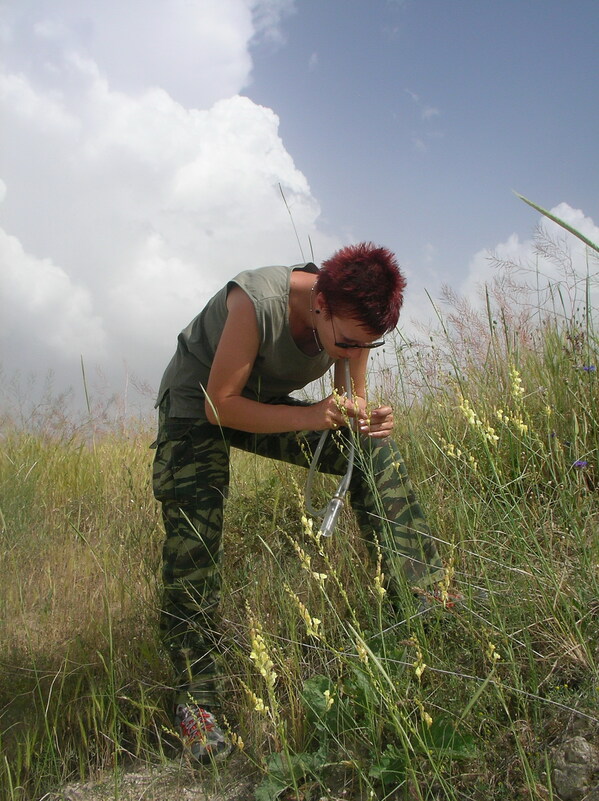
This is Dr. Jelena Jovic- ecologist in taxonomy, psychopathologist in agriculture. This photo, taken during a 2015 field expedition in Turkey, shows what entomological fieldwork actually looks like-no lab coat, no glass beakers, just camouflage clothing to move quietly through tall grass and a mouth aspirator (a simple tube-and-vial tool, sometimes called a "pooter") used to gently collect live insects like leafhoppers and planthoppers straight off the vegetation without harming them. Long days are spent bent over grasses and shrubs in full sun, scanning plant by plant for species too small and fast-moving to catch any other way. It's a fitting image for busting the "mad scientist" myth: the real work of identifying and understanding insect biodiversity happens outdoors, in the field, often on hands and knees in a meadow-not behind a locked laboratory door. Then the story continues in the lab and the results are shared with a world via scientific publication and countless application in agriculture.
FAQ
Is the "mad scientist" stereotype based on anything real?
Barely. It comes almost entirely from fiction-Frankenstein (1931), Cold War monster movies, and shows like Stranger Things-not from how science is actually practiced. Academic analysis of 222 films found the stereotype's core (a male genius in a lab) has stayed remarkably stable despite having little basis in real scientific careers.
Where do scientists actually work, if not in a lab?
In forests and oceans (ecologists, marine biologists), on excavation sites and shipwrecks (archaeologists), in Antarctica (glaciologists and atmospheric physicists), in museums (curators and collections researchers), in universities and PhD programs, and in industry R&D departments. Many scientists split their time between fieldwork and analysis rather than working in a lab at all.
How many scientists are there in the world?
Around 8.8 million researchers worldwide, a number that has been growing nearly three times faster than the global population.
What percentage of scientists are women?
About 33.3% of researchers globally are women, up from 29.4% a decade earlier — though the share varies by region (roughly 23% in South Asia to 34% elsewhere) and by field, with women best represented in social sciences, humanities, and medical/biological sciences, and least represented in engineering and mathematics.
What are the main fields of science?
UNESCO recognizes six: natural sciences, engineering and technology, medical and health sciences, agricultural sciences, social sciences, and humanities and the arts.
---
Sources
Whatever happened to the 'mad, bad' scientist? Overturning the stereotype https://unesdoc.unesco.org/ark:/48223/pf0000393768
The myth of the mad scientist- Big Think
https://bigthink.com/hard-science/the-myth-of-the-mad-scientist/
Nuclear Museum: Atomic Culture
https://ahf.nuclearmuseum.org/ahf/history/atomic-culture/
What it's like to be a polar scientist -National Maritime Museum
https://www.rmg.co.uk/stories/ocean/camping-in-antarctica-deep-field-research-polar-science
Science|Business
https://sciencebusiness.net/news/number-scientists-worldwide-reaches-88m-global-research-spending-grows-faster-economy
UNESCO Institute for Statistics- Researchers per million inhabitants, 2021 Science Report
https://www.unesco.org/reports/science/2021/en/dataviz/researchers-million-habitants
The gender gap in science and technology, in numbers -World Economic Forum
https://www.unesco.org/reports/science/2021/en/dataviz/researchers-million-habitants
UNESCO: Status and trends of women in science
https://www.weforum.org/stories/2021/07/science-technology-gender-gap/
---
About the author: Dr. Zorana Kurbalija Novicic is a scientist, science communicator, and mom based in Uppsala, Sweden. She runs Science Market Uppsala (https://www.sciencemarket.se), offering hands-on science workshops and parties that help kids and families experience real science at home.