Blog

Pedagogical Approximation: The Most Powerful Tool in Science Communication
Pedagogical Approximation: The Most Powerful Tool in Science Communication
By Dr. Zorana Kurbalija Novičić, PhD in population genetics, science communicator and founder of Science Market Uppsala · November 2026 · 7 min read
In short: Pedagogical approximation is the art of explaining a complex scientific idea in a simpler form that is still true, then going deeper step by step as the listener’s understanding grows. It is how one idea, such as pH, can be explained to an 8-year-old, a teenager and a parent without losing its scientific core. In this post I share how I use it after 18 years of science communication, more than 30 international science festivals and about 500,000 children: the explanation ladder for depth, the Science in Three Versions method for breadth, and the one rule that separates good simplification from trivialisation. Whether you are a researcher, teacher, student or parent, this is a tool you can start using tomorrow.
Every autumn at SciFest Uppsala, someone at our Lemon Lab table asks me the same question in a different way. A third-grader asks, “Why is lemon sour?” An eighth-grader asks, “What actually is pH?” A parent asks, “Is lemon water really good for you?”
Three people, one lemon, three completely different starting points. If I give all three the same answer, I lose at least two of them. If I give each of them a different truth, I lose my credibility. The way through is a tool I have relied on for almost two decades: pedagogical approximation.
What is pedagogical approximation?
Pedagogical approximation is a teaching strategy in which complex concepts, processes or theories are deliberately simplified so that listeners can understand them, in line with their age, prior knowledge and cognitive abilities. Educators sometimes call the same family of ideas didactic reduction. The goal is always the same: to explain one scientific idea meaningfully, accurately and clearly to different audiences, without losing its scientific core.
You have met it many times, even if nobody named it. When we tell children that an atom is “a tiny ball”, we know its structure is far more complex. That is a pedagogical approximation: a starting model we will build on later. Physics teachers do it with Newton before Einstein. Biology teachers do it with “genes are recipes” before gene regulation. Good science communicators do it all the time.
In my work, a good approximation always has four characteristics:
Characteristic | What it means in practice |
Simplification without losing the core | Choose the most important elements and leave out details that would overload the listener |
A developmental approach | The explanation changes, grows and deepens as the listener’s understanding grows |
A bridge from everyday life to science | Metaphors, analogies and familiar objects, like a lemon or a red cabbage, connect what people know to what science knows |
A temporary model | An approximation is not the final explanation but a stage in learning, a step on a ladder |
That last point is the one people forget. An approximation is not a lie and not a shortcut. It is a temporary model which, if you think about it, is exactly how science itself works.
Depth: one idea, three levels (a real example from Lemon Lab)
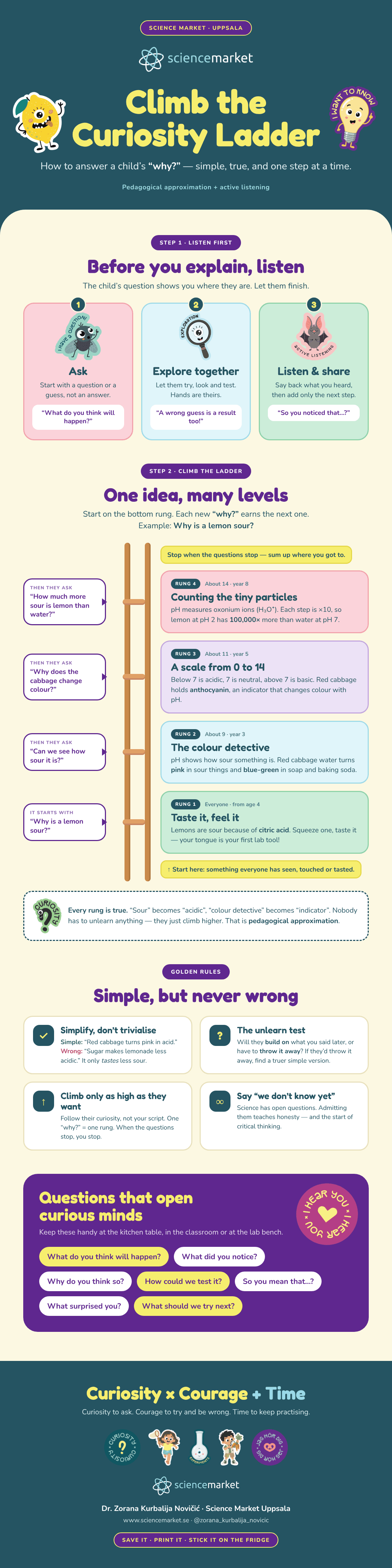
At Lemon Lab at SciFest Uppsala 2026, children tested kitchen liquids with red cabbage water and placed them on the pH scale. In the instructions I wrote for our demonstrators, every station came with three explanations of the same idea. Here is what “What is pH?” looked like:
For grade 3 (about 9 years old): pH shows how sour something is. Lemon and vinegar are sour- you can feel it on your tongue. The opposite of sour is called basic, like baking soda and soap. Water is in the middle, neutral. The pH scale goes from 0 to 14: low numbers are sour, 7 is neutral and high numbers are basic. The red cabbage is our colour detective that shows the answer.
For grade 5 (about 11): pH measures how acidic or basic a substance is, on a scale from 0 to 14. Below 7 is acidic, 7 is neutral and above 7 is basic. The further from 7, the stronger the acid or base. An indicator is a substance that changes colour with pH. Red cabbage contains one, anthocyanin. When an acid and a base are mixed, they can cancel each other out ,that is called neutralisation.
For grade 8 (about 14): pH describes the concentration of oxonium ions (H₃O⁺) in a water solution. The scale is logarithmic: each step means a tenfold difference, so lemon juice at pH 2 has 100,000 times more oxonium ions than pure water at pH 7. Anthocyanin in red cabbage changes its molecular structure when pH changes -and with it, its colour.
Notice what happens. Nothing in the grade 3 explanation is wrong. “Sour” becomes “acidic”, “colour detective” becomes “indicator” and then “molecular structure”. Each level is built on top of the previous one, so nobody has to unlearn anything. That is the explanation ladder: one idea, climbed only as high as the listener wants to go.
Our demonstrators were asked to do one thing before choosing a level: ask which grade the child is in, and then ask, “What do you think will happen?” The answer tells you which rung to start on.
There is a lovely bonus for Uppsala, too. The man who explained what makes things acidic, Svante Arrhenius, defended his doctoral thesis at Uppsala University in 1884. His professors were sceptical and gave it a low grade. The same idea earned him the Nobel Prize in Chemistry in 1903, the first for a Swede. A story like that is its own rung on the ladder: science is made by people, and good ideas sometimes need time.
Breadth: Science in Three Versions
The ladder gives you depth for one listener. But researchers rarely have one listener. The same study may need to reach a school class, a journalist and a funding committee in the same week. That is why I developed a second exercise, Science in Three Versions, which I ran as a workshop made for STEM educators at the Palace of Science in Belgrade in March 2026 in collaboration with Loop foundation.
The idea is simple and demanding at the same time: take one real scientific paper and turn it into three versions for three audiences. The core stays the same; everything around it changes.
Teenagers (15–18) | General public | Children (6–9) |
Start with | The problem the author tried to solve | The problem the author tried to solve | A hero, and the problem the hero tries to solve |
Core content | The logic of the research and a simple version of the method | The main result | The finding as a story, a metaphor or a game |
Connect to | What they learn in science class | Why a non-scientist should care | Something they can touch: a hands-on activity |
Leave out | Unnecessary methodological detail | Formulas and methods | Abstract terms, statistics and definitions |
They remember | The key takeaway, and a reason to read more | One clear message | What the hero discovered |
A useful frame for every version is one sentence: “Scientists tried to answer how X affects Y. They found that… This matters because it could change the way we…”
For most participants, the children’s version is the hardest. It forces you to find the true core of your own research — the part that remains when every technical word is gone. And finding that core is valuable in itself: if you can explain your research to a child, you understand it better yourself.
Together, the two directions make the full structure of pedagogical approximation: depth (the ladder, how far to go with one listener) and breadth (three versions, how to reach different listeners with the same truth).
Simplifying is not trivialising
This is the line every science communicator walks, and it is where approximation earns its value.
- A good approximation leaves out detail but keeps the truth. “Red cabbage turns pink in acid” is simple, and correct.
- Trivialising keeps the words but loses the meaning, or says something the listener will later have to unlearn. “Sugar makes lemonade less acidic” sounds reasonable- and it is wrong. Sugar changes how sour the drink tastes, not how acidic it is. At Lemon Lab, the red cabbage tells the truth.
A quick test before you simplify: If this listener learns more later, will they build on what I said, or have to throw it away? If they have to throw it away, you have trivialised.
Why does this matter so much? Because our children grow up in an information forest: more claims before breakfast than earlier generations met in a month. Oversimplified science - the miracle food, the one study that “proves” everything is exactly what misinformation feeds on. When we model honest simplification, and say “we don’t know yet” when we don’t, we teach something bigger than pH. We teach how to recognise a trustworthy explanation. That is the foundation of critical thinking, and in my view the most important reason to take science communication seriously.
How to use pedagogical approximation: five steps
You do not need a stage or a festival to start. These five steps work in a classroom, a lab meeting, a job interview or at the kitchen table.
- Listen first. Before you explain anything, ask: “What do you think will happen?” or “What do you already know about this?” Let the person finish. The answer shows you which rung to start on. (I write more about this in Active Listening for Families.)
- Find the core. Write the one sentence that must stay true at every level. For pH: “Some things are acidic, some are basic, and we can measure the difference.”
- Start with something everyone has seen. A lemon, a leaf in autumn, a slice of bread. Everyday life is the first rung.
- Climb one step at a time, only as long as curiosity lasts. Each new “why?” is an invitation to the next level. When the questions stop, stop too, and summarise where you got to.
- Check the bridge. Ask yourself: is anything I said something they will have to unlearn? If so, go back and find a truer simple version.
Learning it together
I am a biologist with a PhD in population genetics. I came to Uppsala University in 2015 as a Marie Curie fellow, worked as a researcher at Uppsala University, and then spent more than five years in life science industry and global leadership. Alongside research, I have communicated science since 2007: as programme coordinator at the Belgrade Science Festival, acting director of Serbia’s Centre for Science Promotion, lecturer and programme board member at Petnica Science Center since 2006, and partner in the EU network MARCH – MAke science Real in sCHools. I have taken science to more than 30 international festivals, run a kitchen-science programme at Glunten Montessori in Uppsala for about ten years, written The Scientific Cookbook (BELMA 2025 Special Prize), and built Science Market Uppsala, a mobile hands-on lab for families and schools. Over 18 years, and about 500,000 children, pedagogical approximation has become the backbone of everything I do.
This autumn I trained three university students, Lana, Daniel and Jonathan, as Lemon Lab demonstrators. By the end of SciFest they were adapting every answer to the child in front of them, from grade 3 to grade 8. That is what convinced me that this skill can be taught, quickly, to anyone who cares about science.
So I am now offering it as a masterclass in science communication for researchers, PhD students, teachers, university students and life science companies. In two half-days, participants learn active listening and pedagogical approximation, practise Science in Three Versions on a real scientific paper, and finish by explaining their own research to a real audience. If you would like to bring it to your department, school, company or festival, get in touch.
Read more on the Science Market blog:
- Lemon Lab at SciFest Uppsala 2026: Hands-On Kitchen Science for Kids and Families
- Raising Critical Thinkers: A Parent’s Guide to the Information Forest
- Active Listening for Families: Why It’s a Daily Ritual
- What Does a Scientist Really Look Like? Busting the Mad Scientist Myth
- PISA 2025: Sweden’s Wake-Up Call
- Special Edition: 18 Years of Science Communication
På svenska: Pedagogisk approximation betyder att förklara en svår vetenskaplig idé enklare men fortfarande sant, och sedan fördjupa steg för steg. Dr. Zorana Kurbalija Novičić på Science Market Uppsala visar hur metoden fungerar med pH-exemplet från Lemon Lab på SciFest Uppsala och övningen “Vetenskap i tre versioner”. Läs mer och boka en masterclass på sciencemarket.se.
Frequently asked questions
What is pedagogical approximation? Pedagogical approximation is a teaching strategy in which a complex scientific concept is deliberately simplified to match the listener’s age, prior knowledge and cognitive abilities, while keeping its scientific core true. The explanation is then deepened step by step as understanding grows. It is closely related to what educators call didactic reduction.
What is an example of pedagogical approximation? Explaining pH at three levels: for a 9-year-old, “pH shows how sour something is”; for an 11-year-old, “pH measures how acidic or basic something is on a scale from 0 to 14”; for a 14-year-old, “pH describes the concentration of oxonium ions, on a logarithmic scale.” Each level is true and builds on the one before. Another classic example is describing an atom as “a tiny ball” before introducing its inner structure.
What is the difference between simplifying and trivialising science? Simplifying leaves out detail but keeps the truth, so the listener can build on it later. Trivialising keeps familiar words but loses the meaning, or says something that will later have to be unlearned. A practical test: will the listener build on this explanation, or have to throw it away?
What is the “Science in Three Versions” method? Science in Three Versions is a science communication exercise developed by Dr. Zorana Kurbalija Novičić. Participants take one scientific paper and explain it in three versions: for teenagers (15–18), for the general public and for children (6–9). The scientific core stays the same, while the starting point, examples and language change for each audience.
Why is pedagogical approximation important for science communication? It lets one scientific idea reach very different audiences without losing accuracy. Honest simplification builds trust and critical thinking, and helps people tell reliable explanations apart from oversimplified claims and misinformation.
Where can researchers learn pedagogical approximation in Sweden? Science Market Uppsala offers a masterclass in science communication, led by Dr. Zorana Kurbalija Novičić, for researchers, PhD students, teachers, students and life science companies. It is taught in two half-days in English or Swedish, in Uppsala or at the host’s venue. Contact via sciencemarket.se.