Blog
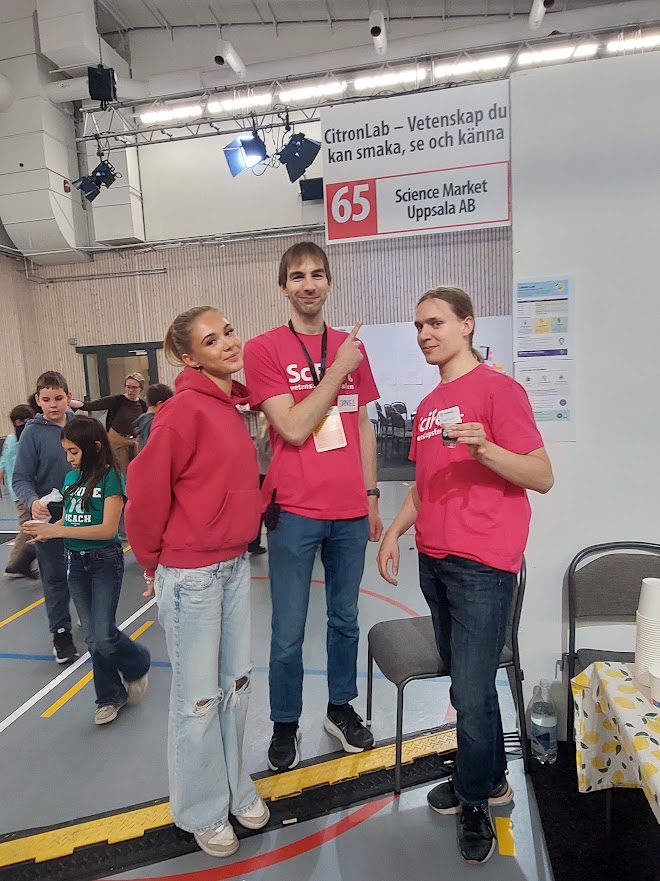
Training Young Science Communicators at SciFest Uppsala 2026: Lana, Daniel and Jonathan at Lemon Lab
Training Young Science Communicators at SciFest Uppsala 2026: Lana, Daniel and Jonathan at Lemon Lab
By Dr. Zorana Kurbalija Novičić, Founder, Science Market Uppsala · October 2026 · 5 min read
In short: At Lemon Lab at SciFest Uppsala 2026, three university students-Lana, Daniel and Jonathan, worked as demonstrators for three days with school classes and families. Watching them, I saw how much young people from universities can give to schools and children: not only knowledge, but a way of living built on curiosity, exploration and critical thinking. This post is a thank-you to them, and an argument for why we should train more young people like them. A strong future society needs strong knowledge, and it starts with the people who share it.
Three demonstrators, three days, hundreds of lemons
SciFest Uppsala 2026 ran from 8 to 10 October at Fyrishov: school classes on Thursday and Friday, families on Saturday. Lemon Lab ran six 45-minute sessions a day. Children rolled and squeezed lemons, made their own lemonade, turned it pink with red cabbage, tested kitchen liquids on a pH scale, and took a lemon seed home to grow.
None of that works without the people at the tables. Lana, Daniel and Jonathan cut lemons, wiped tables, refilled cups and handed out lab sheets all day. But what I will remember is something else.
I watched them explain pH to a class of third-graders, then to fifth-graders, then to eighth-graders and change the explanation every time. That was no accident; we had practised it together. They read the room, started simple, and went deeper only when the children asked “but why?”. That is exactly what we call pedagogical approximation, and by Saturday it looked completely natural.
I watched them hold back when a child held the lemon the wrong way, and wait instead of taking over. They followed our rule: ask before you tell. A wrong guess is still a result. And I saw the moment that makes this work worth it: a child who had never squeezed a lemon before (about 85% of the children at our lemonade station had not) suddenly realising, I can do it myself.
Lana, Daniel, Jonathan: thank you. You were not helpers. You were scientists, teachers and role models at the same time.
How we prepared: practice before performance
Good science communication is not talent. It is preparation and practice. So before the festival opened, I worked with Lana, Daniel and Jonathan the same way I would prepare for a stage: we walked through every station, agreed on two or three key messages for each experiment, and rehearsed our explanations out loud until they felt like our own words.
Active listening first. The most important skill I trained with them was not explaining but listening. A child’s question tells you exactly where their understanding is, if you let them finish. We practised the three steps of our “Listen like a scientist” routine: ask an open question, explore together, then listen and share what the child found. Wait before answering. Say back what you heard. Treat every guess, even a wrong one, as a result. (I write more about this skill in Active Listening for Families.)
Adapting answers with pedagogical approximation. Then we built explanation ladders for each experiment, so the demonstrators could meet any child at their level. For the red cabbage test, the ladder looked like this:
- Lemon tastes sour, and sour is a clue.
- Sour things are acids, and red cabbage water changes colour when it meets an acid.
- Scientists measure how acidic something is on a pH scale from 1 to 14.
- Adding sugar makes lemonade taste less sour, but it does not change how acidic it is the red cabbage tells the truth.
- For the oldest and most curious: what acids actually are, and why the colour changes.
We role-played visitors of different ages, from a shy third-grader to a sceptical eighth-grader and a parent who asks the hardest question of all. Each demonstrator practised climbing the ladder step by step, and stopping as soon as the listener had what they needed.
Learning by doing, all three days. At SciFest itself, the training continued on the floor. Before each day we went through the sessions ahead; between sessions we took a few minutes to share what worked and what to change. I stood beside them when they wanted support and stepped back when they did not. On Thursday and Friday they adapted to school classes from grade 3 to grade 8; on Saturday, with families, the child led the experiment and the adult became the lab partner. By the end of the festival they were not following my method. They were teaching it.
Why young people from university are a gift to schools
When I ask children to picture a scientist, many still see the old movie image: white coat, wild hair, something dangerous in a flask. I wrote about that myth in What Does a Scientist Really Look Like?. Lana, Daniel and Jonathan broke it in seconds. They were young, friendly, curious, and close enough in age that an eighth-grader could imagine being them in a few years.
That closeness is powerful. A university student can say “I didn’t understand this at your age either” and be believed. They remember what was hard. They still ask questions themselves. For a child, they make science feel like a path you can walk, not a closed room.
And the learning goes both ways. Students who explain their field to a nine-year-old discover what they truly understand. They learn patience, listening and clarity-skills every future researcher, doctor, engineer or teacher will need. Universities, schools and children all win.
Most of all, they show that knowledge, curiosity and exploration are not school subjects. They are a way of living.
Why we must establish science communicatio-now
Our children receive more information before breakfast than earlier generations met in a month. Some of it is true, much of it is not, and almost none of it comes with instructions on how to tell the difference. In Raising Critical Thinkers I suggested a simple family habit of four questions for finding your way through that forest. And in my post on PISA 2025 I argued that Sweden’s results are a wake-up call, and that some of the most important skills are ones no score table measures yet.
Science communication is how we close that gap. It is not decoration added after the “real” science is done. It is how knowledge reaches the people who will vote, raise families, run companies and make decisions about climate, health and technology. If scientists cannot explain what they know, someone else will explain it for them and not always honestly.
That is why I believe we need to establish science communication, not leave it to chance and enthusiasm. It should be a skill we train, value and reward, just like research itself. And the best place to start is with young people, because they are the ones who will lead the world very soon.
A society with strong knowledge and strong critical thinking is harder to fool, quicker to solve problems, and kinder in how it disagrees. That is the future I want for my own children, and for every child who squeezed a lemon at Fyrishov.
What comes next: training the next Lanas, Daniels and Jonathans
Lana, Daniel and Jonathan showed me what is possible. Now I want to make it possible for many more students. So I am developing a short, practical training for university student volunteers who want to communicate science to children/ three days, ending on a real festival floor.
Day 1 Audience and message. Who is in front of you? How old are they, what do they know, did they come out of curiosity or with their class? Students learn to drop jargon, use everyday analogies, and build a five-level “approximation ladder”: start with something everyone sees, like leaves change colour in autumn, and go deeper only as long as the audience wants to follow.
Day 2 Story, stage and station. A good explanation is a story with a problem and a discovery. Students write a short script, add a scenario of movement, props and questions, and design a hands-on station with cheap, safe materials and one clear “wow” moment. We also talk about honesty: no exaggeration, no sensationalism, and the courage to say “we don’t know yet.”
Day 3 Rehearsal and dress run. Students watch themselves on video, improve, and then test their stations on a real audience of children and parents. We finish with the practical side: materials, hygiene, breathing, and how to stay calm when thirty eight-year-olds arrive at once.
Then comes the festival itself, where the students run their own stations with coaching on the floor. My hope is to pilot this with a small group next year, measure what works, and grow it from there.
Frequently asked questions
What is pedagogical approximation in science communication? Pedagogical approximation is a way of explaining science that starts with a simple, true statement everyone can follow and then goes deeper step by step, only as long as the listener stays curious. Each step simplifies the science but never says anything wrong, so a child can stop at any level and still leave with a correct understanding.
What is active listening, and why does it matter when teaching children science? Active listening means letting a child finish their question, asking open questions back, and repeating what you heard before you explain. It shows you exactly what the child already knows, so your answer can start at the right level. At Lemon Lab we use a three-step routine: ask, explore together, listen and share.
Why should university students work with schools and children? University students are close enough in age to be real role models, they remember what was hard to understand, and they break the stereotype of the “mad scientist.” Explaining their field to children also deepens their own understanding and builds communication skills they will need in any career.
What is SciFest Uppsala? SciFest Uppsala is a free science festival at Fyrishov in Uppsala, Sweden, organised by Uppsala University and the Swedish University of Agricultural Sciences (SLU). In 2026 it ran from 8 to 10 October, with school classes on Thursday and Friday and families on Saturday. Science Market Uppsala took part with Lemon Lab for the third year.
How can university students get involved in science communication in Uppsala? Science Market Uppsala is planning a short, three-day training for student volunteers who want to run hands-on science stations for children, starting with a small pilot in 2027. Students, teachers and organisations who are interested can get in touch through sciencemarket.se.
Curiosity is a way of living
When I look back on 18 years of science communication, the lesson that keeps returning is simple: knowledge grows when it is shared, and it grows fastest when young people share it with even younger people. A lemon costs a few kronor. A child who discovers I can find out for myself is priceless.
If you are a university student who would like to try this, a teacher who wants young scientists in your classroom, or an organisation that believes in this future, I would love to hear from you. Let’s build it together.
Read more on the Science Market blog:
- Lemon Lab at SciFest Uppsala 2026: Hands-On Kitchen Science for Kids and Families
- Raising Critical Thinkers: A Parent’s Guide to the Information Forest
- PISA 2025: Sweden’s Wake-Up Call and the Skills the Numbers Don’t Yet Measure
- What Does a Scientist Really Look Like? Busting the Mad Scientist Myth
- Curious by Nature: The Story Behind Science Market Uppsala
- Special Edition: 18 Years of Science Communication
På svenska: Vid Lemon Lab på SciFest Uppsala 2026 visade studenterna Lana, Daniel och Jonathan hur mycket unga från universitetet kan ge skolor och barn. Nu vill vi utbilda fler unga vetenskapskommunikatörer. Läs mer på sciencemarket.se.